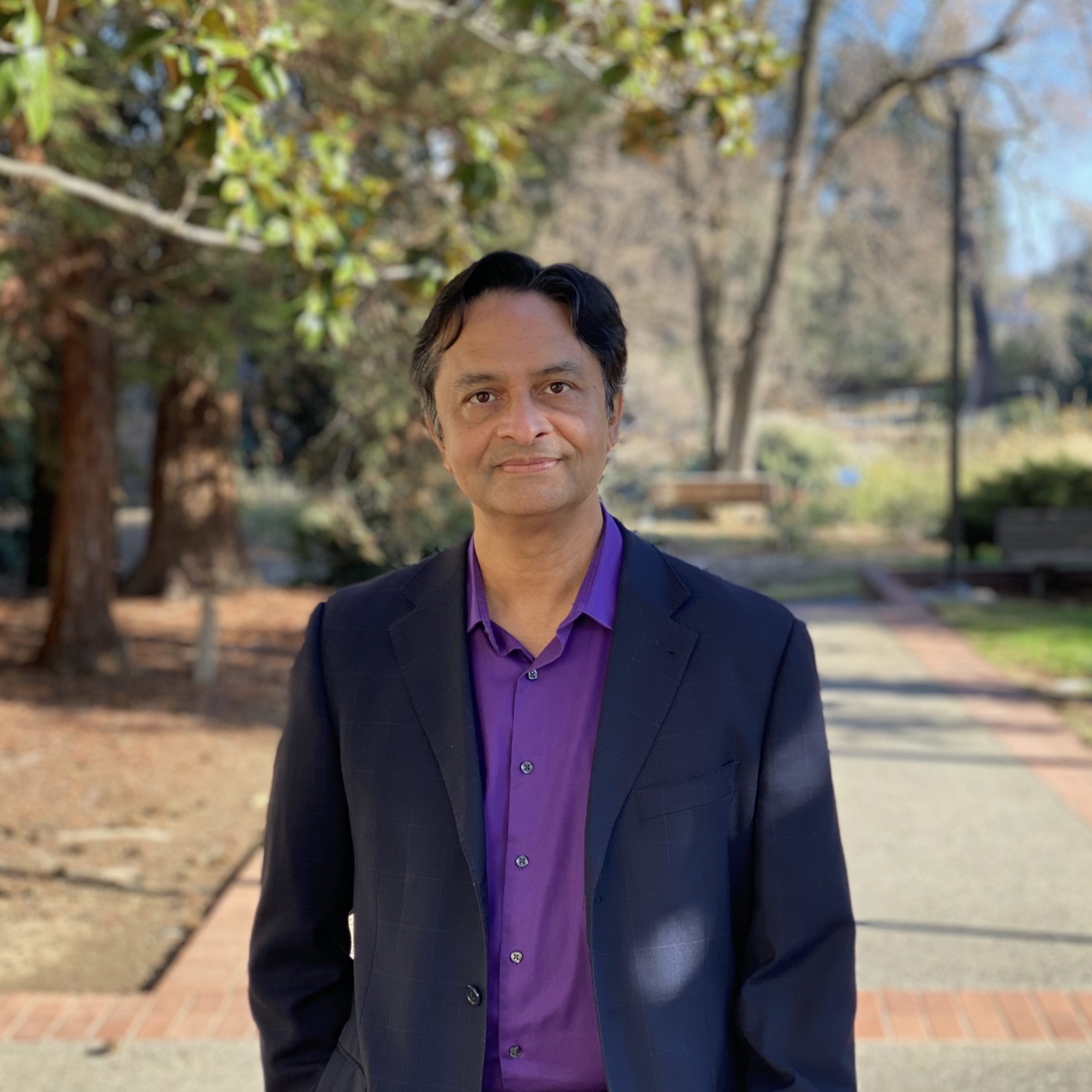
Education and Appointments:
-
Director, The Center for Information Technology Research in the Interest of Society (CITRIS) and the Banatao Institute, UC Davis, 2022-present
-
Professor, Electrical & Computer Engineering, Univ. of California, Davis, CA, 2011-present
- Professor and Chair, Electrical & Computer Engineering, Univ. of California, Davis, CA, 2017-2020
- Director, Center for Nano & Micro-Manufacturing (CNMM), 2012-2014
- Vice Chair , Electrical & Computer Engineering, Univ. of California, Davis, CA, 2011-2013
- Associate Professor, Electrical and Computer Engineering, University of California, Davis, CA, 2008-2011
- Assistant Professor, Electrical and Computer Engineering, University of California, Davis, CA, 2004-08
- Affiliate Faculty, Berkeley Sensors & Actuator Center, BSAC, 2005-2015
- Affiliate Faculty, Davis MM-Wave Research Center (DMRC), 2011-present
- Adjunct Assistant Professor, Department of EE, San Jose State University, San Jose, CA, 2002-03
- Postdoc Research Fellow, Quantum Science Res., Hewlett-Packard Labs, 2002-04, Dr. R. Stanley Williams
- Senior Scientist, Gazilllion Bits, Inc., San Jose, CA, 2001-02, Dr. Shih-Yuan (SY) Wang
- Staff Scientist, Optical Networking Research, JDS Uniphase Corp./SDL Inc., 2000-01, Dr. David F. Welch
- Ph.D. Electrical Engineering, Univ of California, Los Angeles, 2001, Prof. Ming C. Wu
- M.S. Electrical Engineering, Univ of California, Los Angeles (UCLA), 1999, Profs. Ming C. Wu & Tatsuo Itoh
- M.Sc. Physics, Bilkent University, Ankara, Turkey 1996, Prof. Ekmel Ozbay
- B.Sc. Physics with Highest Honors, Middle East Technical University, Ankara, 1994, Prof. Sinan Bilikmen
Honors and Awards:
- Aden and Marjorie Meinel Technology Achievement Award: SPIE, 2024 Link
- Outstanding Senior Research Faculty Award: College of Engineering, UC Davis, 2022 Link
- Fellow, IEEE: The Institute of Electrical and Electronics Engineers, 2020 Link
- Fellow, AAAS: American Association for the Advancement of Science, 2018 Link
- Fellow, NAI: National Academy of Inventors, 2014 Link
- Fellow, OSA: Optical Society of America, 2018 Link
-
Fellow, SPIE: International Society for Optics and Photonics, 2017 Link
- Best Ph.D. Dissertation Mentor: Nano-bridges for the Fabrication of 3D Gate-All-Around Field Effect Transistors, 2014 Link
- Outstanding Mid-career Research Faculty Award, College of Engineering, UC Davis, 2012, Link
- Academic Senate Distinguished Teaching Award: The Highest Teaching Honor University of California Davis Bestows on its
Faculties, 2010, Link
- IEEE Best Paper Award, IEEEICE, Dhaka, Bangladesh, 2010
- IEEE Outstanding Professor of the Year, Electrical and Computer Engineering Department, 2005 & 2009
- Outstanding Junior Faculty Award, College of Engineering, UC Davis, 2006, Link
- NSF Faculty Early CAREER Development Award (2006-11), Link
- Associate Editor: IEEE Photonics Journal, IEEE Transaction of Nanotechnology, IEEE Access, Journal of
Nanophotonics, (2007-8),
Nanphotonics for Communications
- Editorial Board: (i) Science of Advanced Materials, (ii) Nano Communications, and (iii) ISRN Nanomaterials
- Conference Chair, Nanosensing Materials, Devices and Systems 2004, 2005, 2006, 2007; Nanomaterial Synthesis and Integration for Sensors, Electronics, Photonics, and Electro- Optics 2005, 2006, 2007; Nanophotonics for Communication: Materials, Devices and Systems 2006, 2007; Micro-Nanotechnology Sensors, Systems, and Applications 2009, 2010, 2011 and 2012; Nanoepitaxy: Homo and Heterogeneous Synthesis, Characterization and Device Integration of Nanomaterials 2009, 2010.
- Symposium Co-organizer, MRS Negative Index materials: Microwave to Optical, 2006 & Nanocontacts, 2012
- Guest Editor, (a) International Journal of Nanotechnology, 2006-7, Focused Issue on Nanosensors, (b) Applied Physics A: Materials Science & Processing, 2006-7, Focused Issue on Negative Index Materials
- University of California Chancellor's Fellowship, 2000 Link
- IEEE Laser and Electro-Optic Society (IEEE/LEOS) Fellowship, 2000, News Link
- President's Award: The President of the People's Republic of Bangladesh (1989) for ranking first in both secondary (SSC) and higher secondary (HSC) exams in entire Bangladesh (Rajshahi Cadet College)
|
Prof. Islam is a member of the Graduate Group of Chemical Engineering and Material Science, Electrical and Computer Engineering and is affiliated with Davis MM-Wave Research Center (DMRC) NEAT, CITRIS, BSAC and National Institute for Nano Engineering (NINE), Sandia National Laboratories, UCD-METU AOC and NAIST, Japan.
Keywords: nanoscale science and technology, nanodevices, nanoelectronics, nanophotonics, optoelectronics, nanosensors, nanoepitaxy,
nanowire, micro-nanopillars, MEMS/NEMS, molecular junction, molectronics, nanomanufacturing, nano-interfacing, self-assembly, images sensors, photovoltaics, devices for energy conversion and storage, substrateless device fabrication, transfer-printing,
field ionization and emission, devices based on charged particles, negative index materials, metamaterials.
Selected Publications:
- Cansizoglu et al., “Surface-illuminated photon-trapping high-speed Ge-on-Si photodiodes with improved efficiency up to 1700nm arrays”, Photonic Research, 2018. PDF
- Gao, Cansizoglu et al., “Photon-trapping microstructures enable high-speed high-efficiency silicon photodiodes arrays”, Nature Photonics, 2017. PDF
- Kaya, Dryden et al., “Spontaneous delamination via compressive buckling facilitates largescale Ga2O3 thin film transfer from reusable GaAs substrates arrays”,physica status solidi, 2017. PDF
- M. M. Ombaba et al., “Precision stress localization during mechanical harvesting of vertically oriented semiconductor micro- and nanostructure arrays”, Applied Physics Letters, 2014. PDF
- Mark Triplett et al., "High-Precision Transfer-Printing and Integration of Vertically Oriented
Semiconductor Arrays for Flexible Device Fabrication, Nano Research, 2014. PDF
- Jin Yong Oh et al.,
“3D-Transistor Array Based on Horizontally Suspended Silicon Nano-bridges Grown via a Bottom-up Technique”, Advanced Materials, 2014. PDF
- Hakan Karaagac et al., “Enhanced Field Ionization Enabled by Metal Induced Surface States on Semiconductor
Nanotips”, Advanced Functional Materials, 2013. PDF
- Matthew Ombaba et al., “Seamless integration of an
elastomer with electrode matrix and its in-situ conversion into a solid state electrolyte for robust Li-Ion batteries”, Advanced Functional Materials. 2013. PDF
- Ramin B. Sadeghian et al., "Ultralow-voltage field-ionization discharge on
whiskered silicon nanowires for gas sensing applications", Nature Materials, 2011. PDF
- Logeeswaran VJ et al., "A Perspective on nanowire photodetectors: Current status, future challenges and opportunities", IEEE Jour. Selected Topics Quantum Electronics, 2011 (invited). PDF
- M. Saif Islam et al. “Nanoscale Materials and Devices for Future Communication Networks”,
IEEE Communications Magazine, 2010. PDF
- Logeeswaran VJ et al., "Ultra-smooth silver thin films
deposited with a Ge nucleation layer",Nano Letters, 2009. PDF
- A. Choudhry et al.,
"Ultra-low contact resistance of epitaxially interfaced Si nanowires", Nano Letters, 2007. PDF
- M. Saif Islam, et al., "Ultrahigh-density semiconductor nano-bridges formed between two semiconductor surfaces", Nanotechnology, 2004. PDF
- M. Saif Islam et al., "High power and highly linear monolithically integrated distributed balanced
photodetectors", IEEE/OSA Journal of Lightwave Technology, 2002. PDF
- Research Group, ECE Brochure (17MB file),
- Integrated
Nanodevices and Systems Research (Inano)
- Publications: More than 250 journal and conference papers, 42 US patents granted, more than 15 patents pending (in the areas of nanosciences and nanotechnology, optoelectronics and photonics,MEMS/NEMS and sensors), editted 30 books and more than 250 invited talks.
- Collaborations: Tohoku Univ, NAIST-Japan, U Florida, UCSC. UC Berkeley, UC Merced, UIUC, METU, FIU, Bilkent University, HP Labs, ARL, Sandia National Labs, Intel, RTI International, NIST
- We anticipate open positions for graduate students &
postdoctoral research scientists in (i) Ultrafast optoelectronic devices for high-speed optical links , (ii) Nanodevices for printed electronics,
photonics, sensors & energy
conversion. We welcome outstanding undergraduate researchers to our research group. Please contact via email.
- Funding: NSF, CITRIS, ARL, HP Labs, Sandia National Labs (NINE), DARPA MTO, NIST, ARO, RTI International, University of California - Davis, UCOP, NIREC, Qualcomm, Intel, IBM
|